Villa Carlotta / Exploring Spatial Narratives in Garden Design
- Jérôme Burrows
- 13 janv.
- 3 min de lecture
Dernière mise à jour : 31 janv.
Located on the western shore of Lake Como, Villa Carlotta is an 18th-century historic residence renowned for its elegant architecture and multi-level terraced gardens that descend gracefully toward the lake. The site exemplifies a seamless dialogue between built heritage and designed landscape, offering a rare opportunity to study the integration of architecture and nature. The gardens themselves are carefully orchestrated works of landscape design, combining formal terraces, lush groves, and framed perspectives, creating a pathway that is both structured and immersive, where every viewpoint reveals the richness and subtlety of the composition.
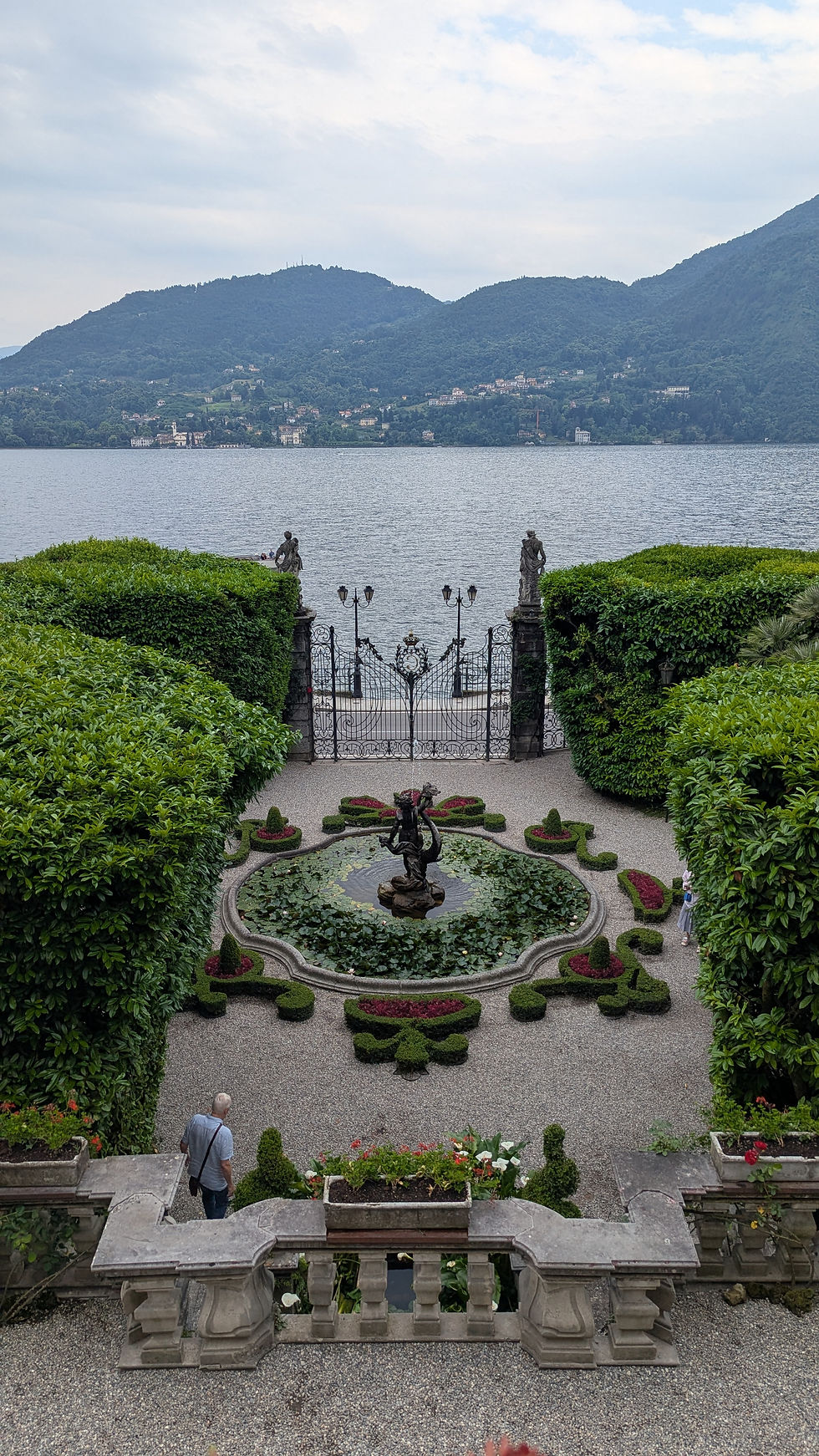
Visiting Villa Carlotta was a truly immersive experience and a profound lesson in landscape composition. From the outset, the garden presents itself as a carefully orchestrated spatial system where each terrace, landing, and line of planting contributes not only to the organization of movement but also to the subtle choreography of sightlines and experiences. The progression through the terraces is conceived as a perceptive sequence thoughtfully alternating formal vistas, long-range views of the lake, and intimate moments enveloped by lush vegetation. Every element, the alignment of plantings, the arrangement of paths, and the framing of distant perspectives, works in concert to guide the visitor's eye and body through the landscape. Each space, each level, and each framing device is deliberately designed to balance openness with intimacy, creating a rhythm of discovery where the visitor is invited to pause, observe, and absorb the intricate dialogue between built form, planting, and topography. The garden does not merely provide visual interest. It orchestrates an experience in time and space, revealing layers of complexity and compositional intent as one moves through it.

The upper terrace, closest to the villa, is characterized by rigorous geometric organization. Masses of rhododendrons and azaleas are arranged with precision, structuring the space and directing sightlines toward the lake. Here, vegetation functions as a material of composition, interacting with architecture and defining the rhythm of the promenade. The pathways and balustrades establish clear axes, offering both orientation and visual surprise.
Descending to the intermediate terraces, there is a subtle transition from formality to naturalism. Pathways become more sinuous, plantings denser, and tree masses more abundant. This gradation creates depth, while viewpoints are carefully orchestrated. A grove may momentarily obscure the lake before revealing it, generating a sense of discovery. This approach to thresholds and visual filters is an instructive example of how to structure movement and perception in landscape design.
The lower terraces, closer to the lake, open onto a more naturalistic landscape, with luxuriant plantings that seem to merge seamlessly with the surrounding environment. Perspectives are amplified by topography and vegetation, creating a harmonious dialogue between garden and site. Here, planting is deployed as a compositional element, modulating views and orchestrating the visitor’s experience.

Another striking feature is the treatment of verticality and levels. Stairs, retaining walls, and changes in elevation are never merely functional. They are compositional devices, structuring movement, framing views, and orchestrating sequences. Each level introduces a new perspective, a new spatial and sensory atmosphere. The interplay of verticality strengthens the three-dimensional perception of the garden, an approach I consider essential in my own practice.

Light and texture play an equally important role. Shifts in sunlight and shadow, combined with contrasting foliage textures, create multiple ambiances throughout the day and across seasons. The garden is a living, dynamic space. As a landscape architect, this reinforces the principle that every plant can act as a compositional element, shaping spatial and sensory experiences.
Ultimately, what resonates most is how Villa Carlotta demonstrates the ability of a garden to combine rigor, sensitivity, and emotion. Every terrace, massing, and viewpoint is part of a coherent landscape narrative, where architecture, planting, and topography engage in a subtle dialogue. The garden illustrates that a successful design is never just decorative. It tells a story, interacts with its context, captures light, orchestrates views, and creates emotional impact.

For me, Villa Carlotta remains a key reference, demonstrating how landscape design can be both technical and sensitive, conceptual and poetic, while remaining deeply rooted in site and context. It is an ongoing source of inspiration, reminding me that each project, whether public or private, can combine detail, perspective, and narrative to create a truly immersive and meaningful spatial experience.
Commentaires